From Signal to Discovery: Roman Coin Hoard Found with Rover C4
What begins as a signal on a screen can sometimes lead to a story buried for centuries. This recent discovery, made with the OKM Rover C4, is a perfect example of how patience, technology, and experience come together in modern treasure hunting.

A Promising Location
The journey began with a OKM Rover C4 user surveying a location that immediately raised curiosity. The scan results indicated irregularities beneath the surface that did not appear to be natural formations.
Rather than random signals, the data suggested a defined subsurface structure. Based on experience and interpretation, the area showed strong potential for a hidden cavity. Motivated by these indications, the team decided to take the next step and begin excavation on site.
Digging Deeper
Excavation started shortly afterwards. As is often the case, the surface revealed nothing unusual at first. Still, the scan data provided enough confidence to continue. The team proceeded carefully and systematically, removing soil layer by layer. Hours passed before the situation changed, and then came the breakthrough. At a depth of approximately four meters, a hidden cavity was uncovered.
This was no natural void. The structure clearly suggested that it had once been intentionally sealed by human hands. What began as a promising signal had now turned into a tangible and highly intriguing discovery.


Bronze Coins from a Hidden Roman Past
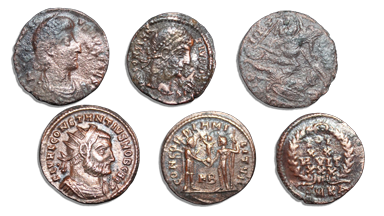
Inside the cavity, the team made a remarkable discovery. As the excavation progressed, they uncovered a collection of ancient bronze coins hidden deep beneath the surface, along with a well-preserved ceramic vessel. The vessel, likely used for storage, adds important context to the find and suggests that the coins were deliberately deposited. Each coin is a fragment of history, offering insight into a time long past. The unearthed coins appear to originate from the Roman Empire and likely date from roughly the 2nd to the 4th century AD. Several pieces feature portraits of Roman rulers, while others display Latin inscriptions and classical motifs on their reverse sides.


Discoveries like these often point to hidden hoards, possibly personal savings, emergency storage, or valuables intentionally concealed during times of uncertainty and never recovered. The presence of the ceramic vessel reinforces the idea of a purposeful deposit rather than a random loss. The fact that the coins were found inside a sealed underground cavity makes the story even more compelling. It raises questions about who hid them, why they were placed there, and what circumstances prevented their return.
Technology Meets Persistence
This find is a powerful reminder that successful treasure hunting is rarely about luck alone. It is about combining reliable technology with experience, patience, and systematic work in the field.
In this case, the OKM Rover C4 played a key role in locating the hidden underground structure. Without the scan data and its careful interpretation, the cavity and its contents would likely have remained untouched beneath the surface.
The discovery highlights the value of:
- accurate 3D ground scanning,
- careful scan data analysis before excavation,
- persistent and methodical fieldwork,
- and the ability to follow a promising signal through to the end.
More Than Just Coins
What makes this discovery so remarkable is not only the coins themselves, but the entire context surrounding them: a hidden cavity, a sealed space, and a story preserved underground for centuries. This is what makes treasure hunting so captivating. Every signal can be the beginning of a new mystery. Every scan can reveal traces of human activity long forgotten. And every discovery creates a connection between modern explorers and the people who once lived, hid, and left these objects behind.
The recovered finds and scan data may still reveal further insights about the site and its history. Was this a deliberately hidden coin hoard? Part of a larger underground structure? Or just one piece of a much bigger story still waiting to be uncovered?
One thing is certain: the ground still holds secrets, and with the right technology, they can be brought to light.
Get Rewarded for Your Treasure Finds
You have also made discoveries and detected amazing artifacts and would like to share them (anonymously)? We look forward to reading and publishing your success stories!

OKM Rover C4 Discovers Possible Commander’s Tomb in Mesopotamia
Archaeological discovery in Iraq: OKM Rover C4 detects coins, statues and possible tomb structures using advanced 3D ground scanning technology.

Silver Coins detected with Ground Scanner Rover C II in the Sechura Desert (Peru)
With the multi-purpose 3D metal detector OKM Rover C II it is possible to detect hidden metal artifacts in different ...

Hidden Treasures Beneath Syrian Soil in 4.5m (15ft) Depth: A Journey into the Byzantine Legacy
Ancient Roman and Byzantine artifacts found in Syria using the OKM eXp 5500 reveal deep cultural layers hidden up to ...